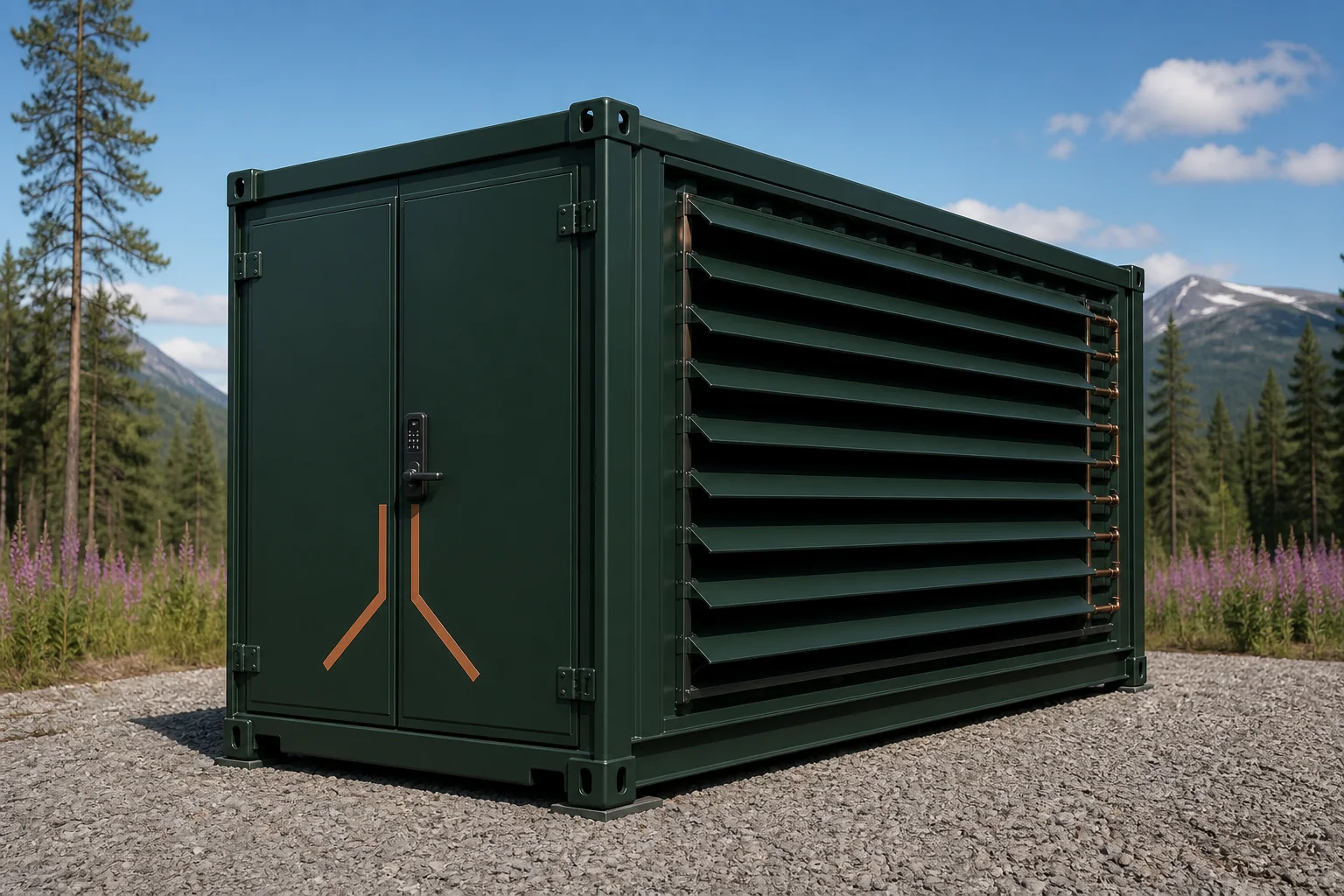
Compute, grid services, Thermal/Heat and mitigation share the connection.
No single stream has to carry the site.
Fully renewable at generation. Reliable because Compute flexes — not because the host pauses.
The service
You keep the plant. Kelvin runs Compute & Flexibility-as-a-Service.
Every large load needs this. Almost none of them can build it.
Industrial host — load in industry
01
You keep operations
Core operations stay yours. Unused connection capacity can be the interruptible megawatt.
02
Flexbox, controller, meters
Hardware, software, infrastructure — with the Compute.
03
Not a bid screen
Kelvin brings the load. Grid signal → the load moves in <0.7 s → the host stays on.
04
A clear event log
Pocket first, then metering and a clear event log. Curtailment at generation is on Energy.
How it pays
Stand-by. Activation. Compute running.
Compute Flexibility is the product. At high prices the load curtails and the reserve is sold — the spike becomes revenue.
01
Stand-by
Availability payments. The unit is ready to move.
02
Activation
Paid when the load moves. Dispatch <0.7 s. Activation just pauses Compute — no cycle penalty.
03
While Compute is running
The baseline whenever the unit is running. Compute keeps earning whenever the grid doesn’t call.
Signal in.Settlement out.
One service from the pocket to settlement.
Qualification, signal, dispatch, metering. System operators pay a premium for fast, controllable load. Built for grid-connected or co-located pads — LV or MV, behind the meter.
Fire and thermal-runaway risk with chemical storage
Revenue
Grid services only
Compute wins on every row.
Optional: Compute on a battery’s existing connection. Both qualify independently; adding a Flexbox does not reduce the battery’s available reserve. Fewer battery cycles. See Energy.
Markets
Built for the Nordic Energy Markets.
Restoration products follow on the same interruptible load.
Faster containment (FFR) is the same sub-second class the unit is built for.
FCR-D — frequency containment.
Why it holds
It’s a Compute Flexibility problem — not a wire problem.
Surplus is switched off because the load cannot move. Heat rides along.
01
Milliseconds, not minutes
Frequency needs a response in milliseconds. Interruptible Compute sheds on firmware signal — first off, first on. The Flexbox is built to move in <0.7 s.
02
A pre-tested unit
On-site controller and industrial-grade smart meters delivered as a single, pre-tested unit with the Compute. Kelvin software: control · dispatch · monitoring.
03
The cheapest megawatt to switch off
Interruptible Compute is the load that can switch off. Batch pauses at a checkpoint. The host never notices. See Compute.
The fleet
Not a building — a control system
Aggregated sites dispatch as one.
Transmission is a multi-year build; a coordinated fleet dispatches in seconds. Built to integrate with grid operators. Market to machine: control, dispatch, monitoring.